
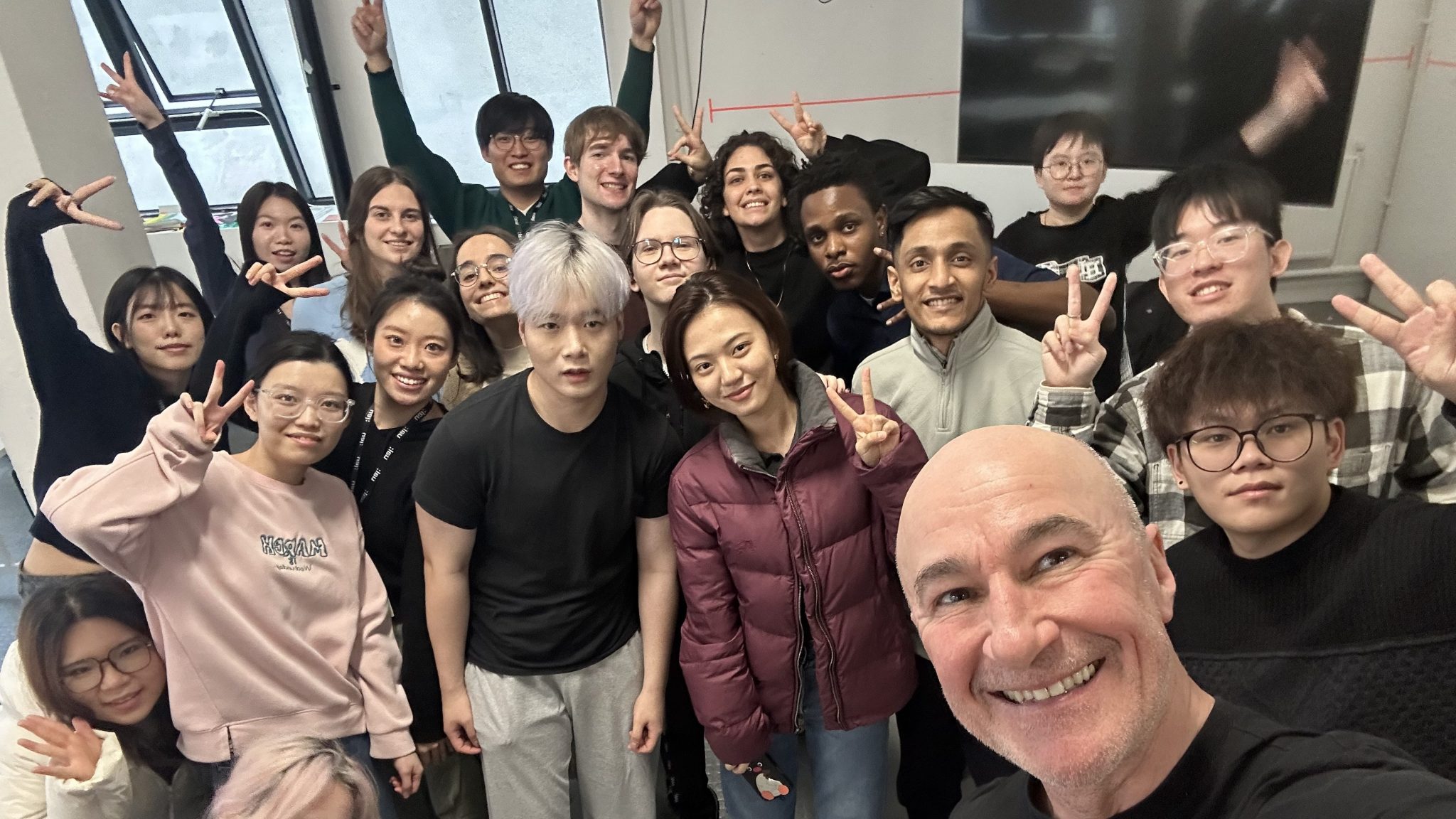
In Week 09 of Advanced 3D Computer Animation, Professor Ting Liu scheduled a practical acting workshop led by a guest tutor. The session focused on performance, observation, and character embodiment. The tutor explained that strong animation begins with understanding believable acting and that animators need to think like performers before creating movement.
Step 1: Introduction and Interactive Games
The workshop included several interactive games that encouraged observation, spontaneity, and physical expression. These exercises helped me become more aware of body language and emotional communication.
Throughout the workshop, I participated in a series of acting exercises and group activities. I explored different emotional situations and physical behaviours, responding to prompts and performing them in front of the class.
Step 2: Persona based Acting
This interesting exercise involved acting like different animals. Rather than simply copying movement, we were encouraged to understand rhythm, weight, behaviour, and personality traits. The tutor explained that even small characteristics can influence how a character performs and reacts.
I choose Rabbit as my Animal.
Step 3: Situation based Acting
Another important lesson was learning to fully place myself within the imagined environment of the character. Instead of thinking about performing in front of an audience, I was encouraged to believe that I was genuinely experiencing the situation. This helped make actions feel more natural and convincing.
Step 4: Prompt based Acting
One of the most engaging activities during the acting workshop was a prompt-based group exercise. The tutor divided the class into two groups and secretly assigned a prompt to one group. The group then had to act out the situation using only physical performance, movement, and interaction, while the other group tried to guess the prompt. After that, the roles were reversed and my group became responsible for interpreting and performing the assigned prompt while the other group attempted to identify it. The activity focused on clear communication through body language rather than dialogue. The movements were simple and involved continuous interaction between performers, requiring us to think carefully about how actions could convey meaning. In the final exercise, all groups worked together to create and perform a prompt of their own, while the tutor attempted to guess the scenario based on our acting. This activity helped me understand how important clarity, intention, and physical expression are when communicating ideas through performance, which directly relates to creating readable and believable animation.
I found the session highly valuable because it directly connected acting principles to animation performance. It helped me understand how emotion, intention, and physical behaviour influence character animation. I learned that believable animation is not only about technical execution but also about understanding the character’s mindset. I plan to apply these observations to future animation projects, particularly when developing stronger performances and more expressive character acting.